3 min audio
Most people treat December as a write-off for job search.
I used to think the same—until I started tracking hiring changes daily across my company list.
What I learned is simple:
December isn’t dead. It’s just uneven. And because it’s uneven, it creates signals that are easy to miss if you only look at job boards.
This post is a December recap (based on daily hiring momentum tracking), plus how I’m preparing for January.
The 3 biggest December patterns I noticed
1) Hiring wasn’t steady — it was “bursty”
Instead of smooth growth, I saw days with:
- high additions,
- sudden removals,
- and short windows where things moved fast.
This is exactly why weekly “momentum” is more useful than just counting open roles.
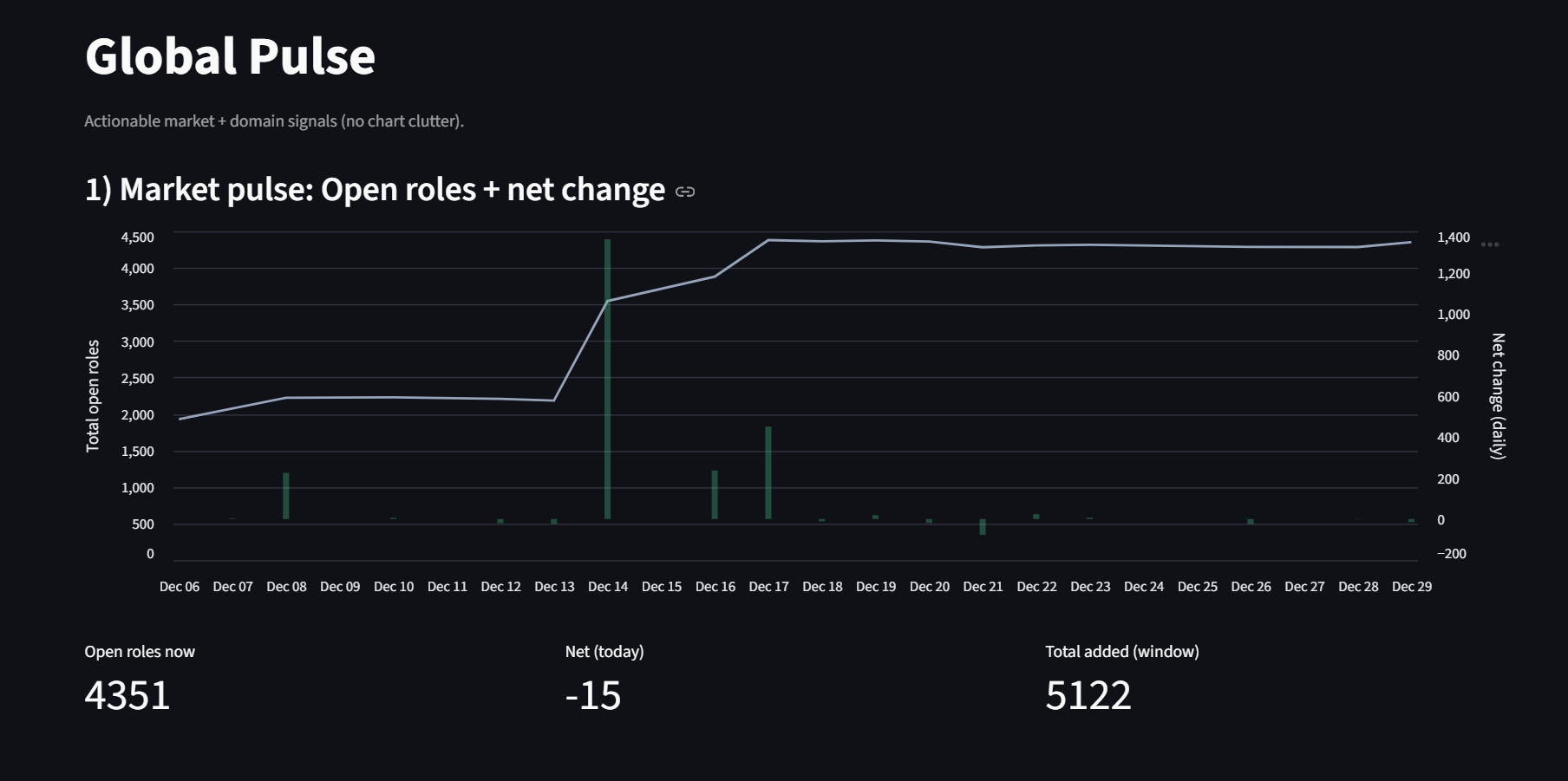 Figure: December movement shows spikes and slowdowns rather than a straight line.
2) “Churn” mattered more than raw volume
A big company can add a lot and remove a lot in the same window.
That creates a different reality than “hiring is up”:
- teams are backfilling,
- roles are being reposted,
- postings can disappear quickly.
So I started watching Added + Removed together, not just “Added.”
3) Many roles were short-lived
This is the most practical December lesson:
If roles close fast, your strategy must change.
For at least some companies in my tracking, the durability signal looked like:
- median open time measured in days (not weeks),
- a large fraction of roles closing within a week.
That implies:
- if you’re applying, you can’t “wait until weekend”
- if you’re networking, earlier is better (you want to be in the loop before the posting)
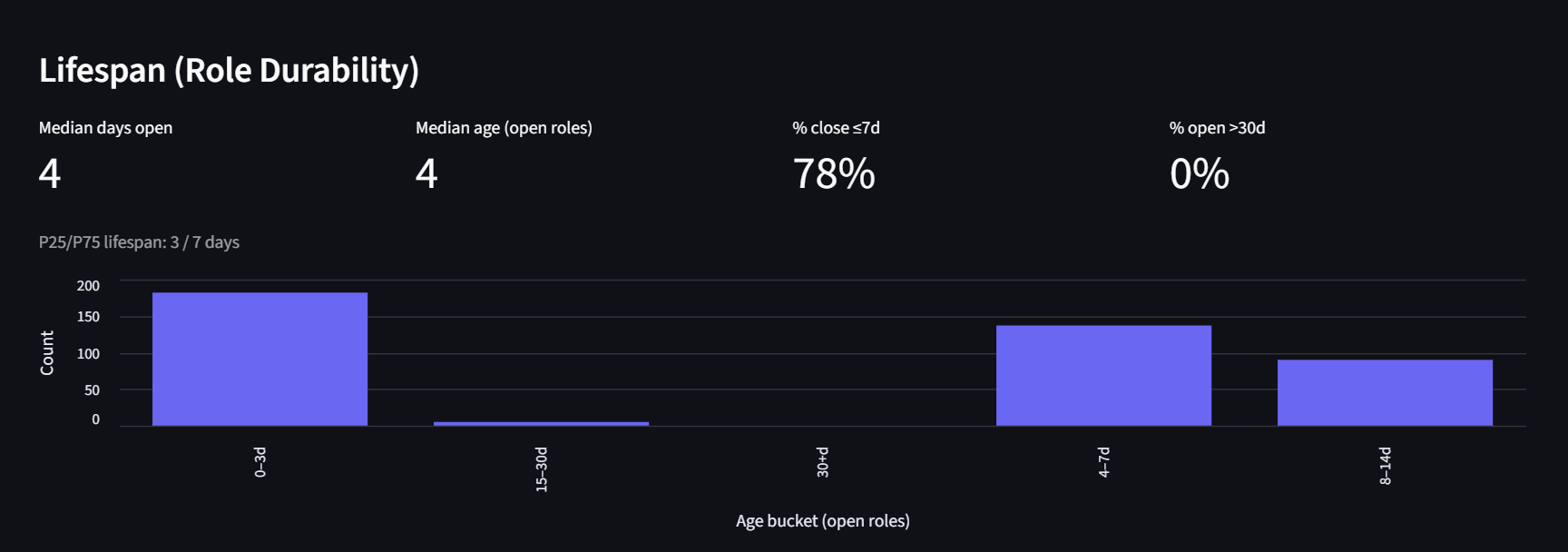 Figure: A company-level view combining daily adds/removes with role lifespan buckets.
Weekday effect: when jobs tend to appear (and disappear)
Once you track daily diffs, an uncomfortable truth shows up:
Hiring activity is not evenly distributed across the week.
So I started looking at:
- which weekdays had the highest additions,
- which had the highest removals,
- and how that changed during the holiday stretch.
Even a simple weekday heatmap makes timing visible.
 Figure: Some weekdays are consistently more “active” than others.
Booming vs freezing: why December can be misleading
December is full of “false calm.”
A company can look stable because:
- it isn’t posting much,
- but it also isn’t removing much.
Another company can look active but be:
- removing a lot (freeze risk),
- or churning (reposts/backfill).
So I tracked a simple distribution:
- how many companies were booming vs freezing vs stable each day/week.
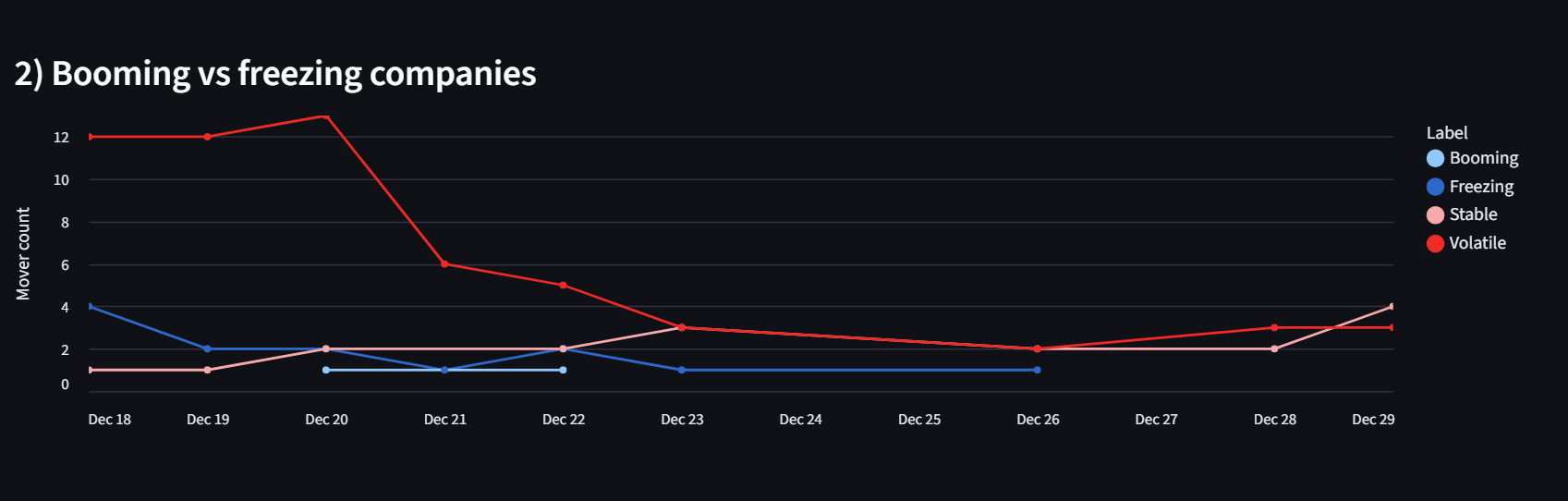 Figure: The market mood changes across December; stability can hide churn.
What I expect in January (and how I’m preparing)
This part is not a guarantee—just a plan based on how hiring usually behaves after holidays plus what December signals suggest.
Likely January dynamics
- Reactivations: paused roles reappear
- New focus areas: fresh headcount priorities show up
- More consistent cadence: fewer holiday-driven gaps
- Faster closing windows: early January can move quickly
My January prep checklist
- Identify companies with late-December momentum (they may carry into January)
- Prioritize companies where roles close fast → be ready to act within 48 hours
- For slow-durability companies → prepare targeted networking and referrals
- Use news only when it aligns with spikes/freezes (context, not distraction)
Why this matters
If you’re applying randomly, December feels quiet and discouraging.
If you watch momentum + durability + weekday patterns, December becomes useful:
- it shows which companies are gearing up,
- which ones are cleaning up,
- and where speed vs networking actually matters.
That’s the mindset I’m taking into January.
Project link (if you’re curious)
I built this tracker for myself and open-sourced it:
GitHub: Repo link Related blog post: Why I built this
Setup instructions are included in the repository.